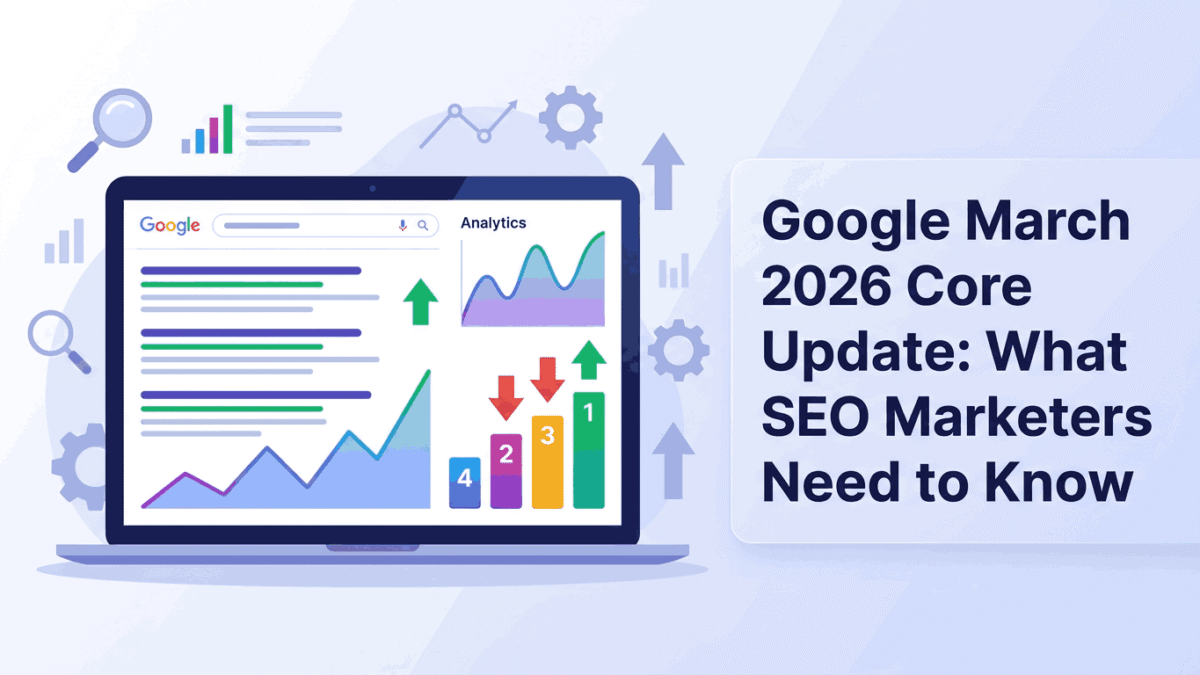
Google’s March 2026 core update has been one of the most disruptive algorithm changes in recent memory. Two major updates landed within a single month. Rankings shifted fast. Traffic dropped for many sites. And SEO marketers are still piecing together what happened.
If you noticed ranking changes in March 2026, this article breaks it all down. What changed, who got hit, and what you should do next.
What Happened in March 2026
March 2026 was a busy month for Google algorithm updates. The month actually brought two separate updates, not one.
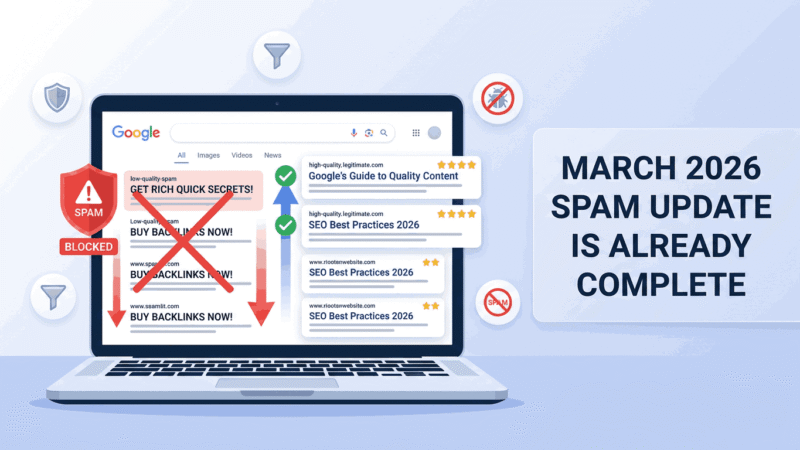
The first was a broad core update that began rolling out in early Feb. It ran for approximately 19 days. The second was the March 2026 spam update, which Google officially released on March 24, 2026. Google confirmed the spam update would apply globally, across all languages and locations. It completed in a matter of days.
Two major algorithm changes within one month created significant SERP volatility. Tools like SEMrush Sensor reportedly showed volatility scores close to 9.5 out of 10. That is extremely high.
The spam update followed the February 2026 Discover core update, which completed on February 27. So in reality, Google pushed out three significant algorithm changes in just about a month.
What Is a Google Core Update?
Before going further, it helps to understand what a core update actually is.
A core update is a broad change to Google’s main search algorithm. It does not target one specific issue or tactic. Instead, it re-evaluates how Google assesses content quality, relevance, expertise, and user satisfaction across the entire web.
Core updates do not penalize sites directly. They recalibrate how Google scores content. Some sites that were already strong move up. Others that were borderline drop down.
A spam update is different. It specifically targets content or practices that violate Google’s spam policies. This includes things like manipulative link schemes, low-quality scaled content, and cloaking.
The Google March 2026 core update combined both types of scrutiny in one month.
What the Core Update Targeted
Industry analysis points to several clear focus areas in this update.
E-E-A-T signals became even more important. Google continued tightening its evaluation of Experience, Expertise, Authoritativeness, and Trustworthiness. Sites that clearly demonstrate who wrote the content, why they are qualified, and what real experience backs it up performed better.
AI-generated content faced stricter checks. Google’s algorithm changes in March 2026 did not ban AI content outright. But sites relying heavily on thin, mass-produced AI content saw significant drops. The algorithm appears better at identifying content that lacks original insight or first-hand experience.
Parasitic SEO was targeted. This refers to low-quality content sections published on otherwise authoritative domains. These sections were algorithmically decoupled from the broader domain’s authority. A strong domain reputation no longer protects weak content published on that same domain.
User intent matching was tightened. Pages that technically cover a keyword but do not fully satisfy what users are actually looking for lost rankings. Google’s ability to assess intent fit appears more refined.
Topical depth matters more. Google is now evaluating whether a site demonstrates deep expertise in a focused area. A website covering dozens of unrelated topics is at a disadvantage compared to one with concentrated, authoritative content in a clear niche.
Who Got Hit and Who Gained
The impact was not even across industries. Some sectors felt it much more than others.
| Sector | Impact |
|---|---|
| E-commerce | Heavy volatility; trust and expertise signals became critical |
| Healthcare & Finance | Significant shifts; YMYL content held to strict E-E-A-T standards |
| Technology | Major shuffling; original research rewarded, generic content dropped |
| News & Media | Mixed results; timely, original reporting gained; clickbait lost |
| Niche content sites | Low-effort sites saw steep traffic declines |
Sites that gained visibility shared common traits. They published original content backed by real data, first-hand experience, or expert commentary. They had clear authorship. And their technical performance was solid.
Sites that lost visibility tended to rely on summarized or AI-generated content without original insight. Some had thin topical coverage. Others had slow page load times or poor Core Web Vitals.
Reports suggest that over 55% of sites saw measurable ranking changes within two weeks of the rollout starting.
The March 2026 Spam Update
The spam update that followed on March 24 was a separate but related event.
Google described it as a standard spam update, rolling out across all languages and locations. It was expected to complete in just a few days.
Google’s spam-prevention system, SpamBrain, is an AI-based tool that continuously monitors for content violating its policies. Spam updates happen when Google makes notable improvements to how that system detects spam.
If your site saw traffic or ranking changes around that date, the spam update may be the cause, not the core update. The two events are related in timing but separate in what they evaluate.
Google advises any site affected by a spam update to review its spam policies. Making the necessary improvements can help, but recovery may take months, as Google needs time to reassess the site.
What This Means for SEO Strategies
The Google March 2026 core update is a clear signal about where SEO is heading. Here is what the data and analysis suggest.
Original content is the most durable SEO asset. Proprietary data, original research, expert interviews, and first-hand accounts are what Google is rewarding now. Content that could have been written by anyone about anything is losing ground fast.
Author trust and E-E-A-T are non-negotiable. If your content does not clearly show who wrote it and why they are qualified, fix that. Bios, author pages, credentials, and links to subject matter experts all contribute to trust signals.
Technical performance is a ranking factor, not just a nice-to-have. Core Web Vitals are increasingly influencing rankings. Largest Contentful Paint (LCP) should be under 2.5 seconds. Sites with slow load times saw drops. Google’s systems are now placing more weight on page speed and mobile usability.
Topical authority beats keyword coverage. Building a cluster of deeply related content around a core topic is more effective than scattered content across multiple unrelated areas. Google evaluates sites at a topic level, not just a page level.
AI Mode and AI Overviews change the stakes. As Google’s search results increasingly include AI-generated summaries and AI Mode responses, the content that gets cited in those results matters. Original, authoritative content is more likely to be pulled into AI Overviews. Thin, summarized content is less likely to appear there.
How to Recover If Your Site Was Affected
If you saw traffic or ranking drops in March 2026, here is a practical starting point.
- Audit your content. Use Google Search Console and GA4 to identify which pages dropped. Look for patterns. Were they thin pages? AI-heavy content? Low author credibility?
- Strengthen E-E-A-T signals. Add or update author bios. Make clear who wrote each piece and what their expertise is. Link to credible external sources where relevant.
- Fix technical issues. Run a Core Web Vitals report. Address slow LCP scores, layout shifts, and mobile usability problems. Page experience is a real ranking factor now.
- Build content depth, not just length. Update affected articles to go deeper on the topic. Add original insights, examples, or data. Remove anything generic that adds no real value.
- Review your content for intent match. Ask whether each page fully answers what a user actually wants when they search that query. If not, restructure or rewrite it.
- Check your link profile. If you suspect the spam update was the trigger, review inbound links for anything manipulative or low-quality. Disavow where necessary.
Recovery from a core update can take time. Google needs to recrawl your site and re-evaluate the improvements. This often means waiting until the next core update to see full recovery reflected in rankings.
What to Watch Going Forward
The March 2026 updates are part of a longer trend. Google’s algorithm changes over the past year have consistently pushed in the same direction: toward original content, real expertise, clean technical performance, and genuine user value.
AI-powered search is changing how SERPs look and function. AI Overviews are appearing for more queries. AI Mode is being tested. The content that earns visibility in those results is the same content that earns visibility in traditional rankings: authoritative, original, and truly useful.
The sites that are holding and gaining ground are not doing anything clever or complicated. They are publishing content that helps real people, written by people with real knowledge, on sites that load fast and work well.
That has always been the goal. The Google March 2026 core update just makes the standard harder to ignore.
Conclusion
The Google March 2026 core update was one of the more significant algorithm changes Google has pushed in recent months. Combined with the March 2026 spam update, it created real disruption across SERPs.
The clearest lesson from this update is that shortcuts no longer hold. Mass-produced content, thin AI output, and weak author signals are losing ground. Original expertise, technical quality, and genuine user value are what the algorithm is rewarding.
For SEO marketers, the path forward is straightforward, even if the work is not easy. Audit what you have, fix what is weak, and commit to content that actually earns its place in search results.