Google’s March 2026 spam update rolled out on March 24, 2026 and completed within roughly 24 hours. That makes it one of the fastest spam update rollouts in recent memory. Rankings shifted quickly, and for many sites, the impact was felt almost overnight.
This article breaks down what the update targeted, who won and lost, and what recovery actually looks like.
What This Update Was – and What It Was Not
This was a standard spam update. No new policies were introduced. No new spam categories were added. Google enforced its existing spam guidelines with better detection capability, not different rules.
That distinction matters. Sites that were penalized were not caught off guard by changed goalposts. They were caught by the same policies that have always existed, now enforced with more precision.
The key spam violations this update targeted include:
- Cloaking — showing different content to Google than to users
- Thin and low-value content — scraped, templated, or shallow pages that offer no real value
- Keyword stuffing and hidden text — old-school manipulation tactics still in use
- Scaled AI-generated content — mass-produced AI output with no human editing or original insight
- Thin affiliate pages — pages built purely to earn clicks and commissions with no added value
This was not a link spam update. Manipulative backlinks are always against Google’s policies, but they were not the primary focus of this particular rollout.
How SpamBrain Made This Happen So Fast
The speed of this update comes down to SpamBrain, Google’s AI-based spam detection system. Unlike older rule-based systems, SpamBrain uses machine learning to continuously scan patterns across billions of pages.
It does not wait for a human to flag a site. It identifies known spam patterns automatically, adapts to new manipulation tactics without manual input, and applies penalties at scale across multiple sites at once.
The sub-24-hour rollout is a direct result of SpamBrain’s growing maturity. This is no longer a system that needs days to process and apply penalties. Detection and enforcement are becoming close to real-time. That means sites relying on loopholes or grey-area tactics have far less time to react before the damage is done.
Who Got Hit and Who Gained
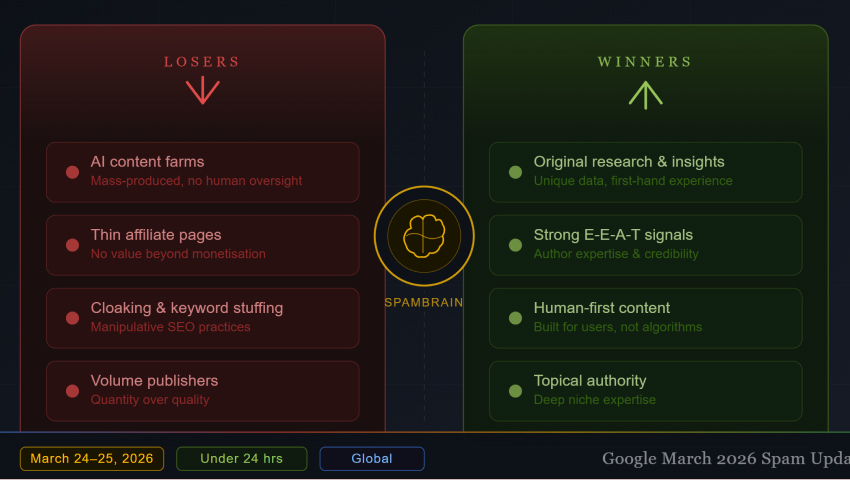
The update created clear losers and clear winners.
| Category | Outcome |
|---|---|
| AI content farms with no human editing | Significant ranking drops |
| Thin affiliate sites with templated pages | Lost visibility |
| High-volume publishers prioritizing quantity | Demoted across keywords |
| Sites with original research and unique insights | Rankings improved |
| Content with clear author expertise and E-E-A-T signals | Gained visibility |
| Human-first content built around user intent | Rewarded |
The pattern is consistent with every update Google has rolled out over the past two years. Volume without value is penalized. Depth, originality, and genuine expertise are rewarded.
How to Tell If Your Site Was Affected
The rollout window was March 24 to March 25. That is your diagnostic window. Start here:
Google Search Console is the first place to check. Pull your Performance report and compare traffic and impressions from March 24 onward against the week prior. A sharp, sudden drop beginning on those dates is the clearest signal of spam update impact.
Keyword tracking tools like SEMrush or Ahrefs can show whether rankings dropped across multiple keywords or just one or two. A broad drop across many keywords suggests a site-level issue. A narrow drop points to specific pages.
GA4 organic traffic data helps confirm the pattern. Look at sessions from organic search before and after March 24. Check whether engagement metrics like bounce rate or session duration also shifted. A penalty typically shows both a traffic drop and a change in how users interact with remaining pages.
Note that SpamBrain operates without manual notifications. You will not receive an alert in Search Console the way you would with a manual action. A traffic drop is often the only signal.
Recovery: What Actually Works
Recovery from a spam update is possible but takes time. Google needs to recrawl and reassess your site after you make changes. That process cannot be rushed, and in most cases it takes weeks to months.
Here is what to focus on:
Audit your content. Identify thin pages, duplicate content, and any AI-generated material published without genuine human oversight. Remove what adds no value. Improve what does. A smaller site with consistent quality outperforms a large site with weak pages scattered throughout.
Fix the violations. Go through Google’s spam policies and honestly audit your site against each one. Cloaking, keyword stuffing, automated bulk publishing, and content created for rankings rather than users are all targets. If any of these are present, removing them is the only way forward.
Strengthen E-E-A-T signals. Add author bios that reflect real credentials and experience. Include case studies, first-hand data, and expert insights in your content. Pages that demonstrate genuine expertise hold up better to spam updates than generic content, regardless of how well-optimized it is technically.
Normalize your publishing pace. Sudden spikes in content output, like hundreds of pages published in a short period, can signal automated generation. Shift toward consistent, quality-driven publishing rather than volume bursts.
Be patient. Google’s documentation is clear: recovery depends on algorithmic reassessment, not a switch you can flip. Sites that make genuine improvements and stay compliant tend to recover over time. Those that chase shortcuts continue to struggle.
What This Means for Your SEO Strategy
The March 2026 spam update is not an isolated event. It is part of a clear direction Google has been taking for years, now executed with more speed and precision than before.
A few practical takeaways:
AI is not banned. Low-quality content is. Using AI to support research, structure outlines, or improve readability is fine. Using it to generate large volumes of publish-ready articles with no editorial oversight is exactly what this update targets.
Topical authority matters more than keyword coverage. Building deep, well-researched content clusters around a focused niche consistently outperforms scattered content across unrelated topics. Google evaluates sites at the topic level, not just the page level.
The enforcement cycle is getting faster. The sub-24-hour rollout signals that future spam updates may also move quickly. Waiting to act after a penalty is increasingly costly. Staying proactively compliant is the safer approach.
Conclusion
The Google March 2026 spam update completed in roughly 24 hours, enforced existing policies more aggressively, and penalized sites that prioritized rankings over real user value. SpamBrain’s growing precision means enforcement is faster and more targeted than ever.
If your site was hit, the path forward is straightforward: audit your content, remove what does not serve users, fix policy violations, and build toward genuine topical authority. There is no shortcut to recovery. And given the direction Google is heading, there is no shortcut to long-term rankings either.