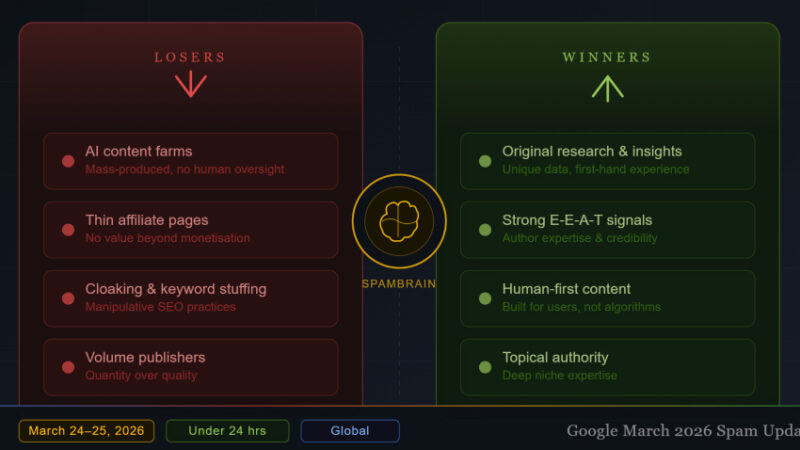
The Google March 2026 spam update has wrapped up. It started on March 24, 2026, and was done by March 25. The entire rollout took less than 20 hours. That is the fastest confirmed spam update rollout in Google’s Search Status Dashboard history.
If your rankings or traffic shifted on March 24 or 25, the dust has already settled. The impact is already baked into search results. Here is everything you need to know.
The Rollout Is Done — Here Are the Exact Timelines
Google began the March 2026 spam update at 12:00 PM PT on March 24, 2026. The release note was posted at 12:18 PM PDT. It completed at 7:30 AM PT on March 25, with the completion note confirmed at 7:39 AM PDT.
That is a total rollout window of just under 20 hours.
To put that in context, here is how it compares to recent spam updates:
| Spam Update | Start Date | Duration |
|---|---|---|
| March 2026 | March 24, 2026 | Under 20 hours |
| August 2025 | August 26, 2025 | ~27 days |
| December 2024 | December 2024 | ~7 days |
| March 2024 | March 2024 | ~14 days |
| October 2023 | October 2023 | ~15 days |
This was not a slow, gradual rollout. It hit fast. Any sites that were going to be affected were affected within a single day.
What the Update Actually Targeted
Google described this as a standard spam update. It applied globally and to all languages. No new spam policy categories were introduced.
This is an important distinction. Unlike the March 2024 update, which added new categories like scaled content abuse, expired domain abuse, and site reputation abuse, this update did not change the rules. It enforced the existing ones better.
Google’s SpamBrain system, its AI-based spam detection engine, is what drove this update. Spam updates happen when Google improves how SpamBrain identifies violations. The March 2026 update appears to have been a refinement of detection capability, not a policy overhaul.
The existing spam policies that remain in scope include:
- Cloaking — serving different content to users than to Google’s crawlers
- Link spam — manipulative link building to artificially boost rankings
- Content abuse — mass production of low-quality or misleading content
- Scraped content — republishing content from other sources without added value
- Expired domain abuse — repurposing old domains to exploit their backlink history
Google did not publish a companion blog post with this release, which further supports the reading that this was enforcement, not a new policy shift.
How Is This Different From a Core Update?
A lot of SEO marketers mix up spam updates and core updates. They are not the same thing.
A core update is a broad reassessment of how Google evaluates content quality across the entire web. It recalibrates rankings based on factors like relevance, expertise, and user satisfaction.
A spam update is more targeted. It enforces Google’s spam policies. It goes after specific violations. And the consequences can be severe.
| Update Type | What It Does | Recovery Path |
|---|---|---|
| Core Update | Re-evaluates content quality broadly | Improve content quality and E-E-A-T |
| Spam Update | Penalizes policy violations | Fix violations; recovery takes months |
The March 2026 spam update falls squarely in the second category. It is not about content quality in a general sense. It is about whether your site is breaking Google’s rules.
What the Speed of This Rollout Tells Us
A sub-20-hour spam update rollout is not typical. Previous updates took days, weeks, or in the case of August 2025, nearly a month.
The speed suggests Google’s automated systems had already pre-identified the sites it was targeting. This was not a gradual re-crawl and reassessment. It looks more like targeted enforcement on previously flagged signals.
That matters for SEO marketers. It means Google does not always need a long window to act. When SpamBrain has sufficient confidence in its detections, enforcement can happen fast.
It also means recovery will not come from waiting out the rollout. The window is closed. If your site was penalized, the next step is remediation, and that process takes time on your end too.
How to Tell If Your Site Was Hit
The rollout window was March 24 to March 25. That is your diagnostic window.
Open Google Search Console and pull your Performance report. Filter the date range to start on March 24 and compare against the week prior. Look for:
- A sharp drop in impressions or clicks beginning on March 24 or 25
- Pages that have fallen significantly in rankings or disappeared from SERPs entirely
- A drop concentrated in a specific section of your site, not spread evenly
A site-wide, sudden drop starting on that date is the clearest sign of spam update impact. If you see gradual movement over several days, that is more consistent with normal SERP fluctuation than a spam penalty.
Because the rollout was so fast, there is no need to wait for things to settle. The data you need is already in Search Console.
What Comes Next If You Were Affected
Recovery from a spam update is possible, but it is not quick. Google is clear on this in its own documentation: automated systems need to detect sustained compliance before rankings are restored, and that can take months.
Here is where to start:
Review Google’s spam policies in full. Go through each category and honestly assess whether anything on your site could qualify as a violation. The relevant framework is the existing policies, since no new ones were added with this update.
Audit your backlink profile. If you have accumulated low-quality or manipulative inbound links, use Google Search Console’s links report to identify them. Be aware that for link spam specifically, removing spammy links does not recover lost rankings. When Google’s systems stop counting those links, any benefit they provided is permanently lost.
Address scaled or scraped content. Any content that exists in volume without original insight or value is a risk factor. Assess whether these pages serve users or just exist to capture keyword traffic.
Make the changes and document them. Recovery requires Google’s systems to detect your site is now compliant. That detection happens over time. Rushing it is not possible, but documenting your remediation timeline can be useful if you ever need to submit a reconsideration request.
This Update vs. the February 2026 Discover Update
The March 2026 spam update arrived roughly three weeks after the February 2026 Discover update completed its rollout.
Those are two separate things. The Discover update affected content surfaced through Google’s Discover feed. The spam update targets organic search rankings for sites violating spam policies. If your traffic dropped in late February or early March, the Discover update is a more likely culprit. Drops concentrated on March 24 to 25 point to the spam update.
Keeping a clear timeline of when changes happened in your analytics is one of the most useful diagnostic tools you have when multiple algorithm changes land close together.
What This Means for Your SEO Strategy Going Forward
The Google March 2026 spam update reinforces a straightforward principle: Google’s enforcement is getting faster and more precise.
SpamBrain is improving. The fact that a global spam update could complete in under 20 hours signals that Google’s confidence in its spam detection has reached a level where it no longer needs extended rollout windows to act. This is the shortest confirmed rollout in dashboard history, and it will likely not be the last fast one.
For SEO marketers, the implication is that practices once considered low-risk because enforcement was slow or inconsistent now carry more immediate consequences. Manipulative links, thin content, cloaking, and scraped material are being caught faster than before.
The algorithm changes underpinning updates like this are not new in direction. They have consistently pointed toward the same outcome: sites that earn their rankings through genuine value hold them. Sites that shortcut the process lose them, and increasingly, they lose them quickly.
Conclusion
The Google March 2026 spam update is complete. It launched on March 24, 2026, and finished in under 20 hours, making it the fastest spam update rollout on record. It is global, covers all languages, and enforced existing spam policies with no new categories introduced.
If your rankings dropped on March 24 or 25, the cause is already confirmed. Check Search Console, audit your site against Google’s spam policies, and start the remediation process with realistic expectations about the timeline for recovery.
The update was fast. The cleanup will not be.